If a client, investor, or regulator has asked you for your carbon footprint, your first reaction is usually:
“Okay… what exactly do we need to collect?”
Most companies assume carbon calculation is a technical formula problem.
It’s not.
It’s a data problem.
Carbon footprint calculation depends entirely on the accuracy and completeness of your documentation. Without structured records, even the best calculation methodology won’t produce reliable results.
Let’s break this down properly — including the documents required, the step-by-step calculation process, verification, certification, and what businesses often miss.
First: What Is Carbon Footprint Calculation?
Carbon footprint calculation measures the total greenhouse gas (GHG) emissions generated by your organisation.
It usually includes:
- Scope 1 (Direct emissions)
- Scope 2 (Purchased electricity emissions)
- Scope 3 (Indirect value chain emissions)
The calculation follows global standards like:
- GHG Protocol
- ISO 14064
- BRSR reporting framework (India)
- CBAM reporting requirements (for EU exporters)
The result is expressed in tons of CO₂ equivalent (tCO₂e).
What Documents Are Required for Carbon Footprint Calculation?
Let’s divide this by emission scope for clarity.
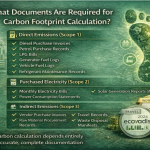
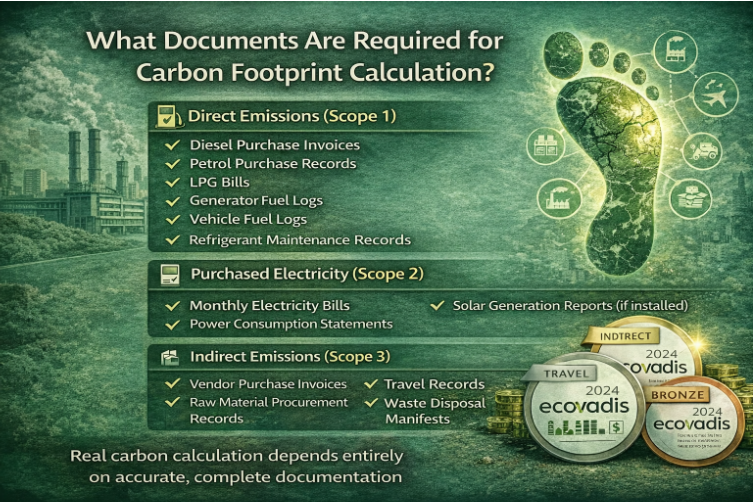
1. Documents Required for Scope 1 Emissions (Direct Emissions)
Scope 1 includes emissions from sources owned or controlled by your company.
This includes:
- Fuel used in generators
- Fuel used in company-owned vehicles
- Natural gas consumption
- Diesel consumption
- LPG usage
- Refrigerant leakage (if applicable)
Required Documents:
- Diesel purchase invoices
- Petrol purchase records
- LPG bills
- Natural gas consumption bills
- Generator fuel logs
- Vehicle fuel logs
- Maintenance records for refrigeration systems
- Records of refrigerant refill or leakage
These documents help calculate fuel-based CO₂ emissions using emission factors.
2. Documents Required for Scope 2 Emissions (Purchased Electricity)
Scope 2 includes emissions from electricity purchased and consumed.
Required Documents:
- Monthly electricity bills
- Power consumption statements
- Utility meter readings
- Renewable energy purchase agreements (if applicable)
- Solar generation reports (if installed)
Electricity bills are usually the most straightforward data source.
Emission calculations depend on grid emission factors.
3. Documents Required for Scope 3 Emissions (Indirect Emissions)
Scope 3 is the most complex and often the largest emission source.
It includes:
- Purchased goods and services
- Transportation
- Business travel
- Employee commuting
- Waste disposal
- Distribution
- Supply chain emissions
Required Documents:
- Vendor purchase invoices
- Raw material procurement records
- Freight bills
- Logistics invoices
- Business travel tickets
- Air travel records
- Waste disposal manifests
- Hazardous waste records
- Employee commuting survey data
- Outsourced service provider data
Scope 3 data is often the most difficult to collect.
Many companies underestimate this stage.
How to Calculate Carbon Footprint Step by Step?
Here’s a simplified business-level process.
Step 1: Define Organisational Boundary
Decide:
- Which locations are included?
- Which subsidiaries are included?
- Which operational units are covered?
Without a boundary definition, calculations become inconsistent.
Step 2: Define Reporting Period
Usually:
- Financial year
- Calendar year
Consistency matters for year-on-year comparison.
Step 3: Collect Activity Data
Gather all fuel, electricity, procurement, and transport data.
This is where document collection becomes critical.
Step 4: Apply Emission Factors
Multiply activity data by relevant emission factors.
Example:
Diesel consumed (liters) × Emission factor = CO₂ emissions
Emission factors come from:
- IPCC guidelines
- Government databases
- Country-specific grid factors
Step 5: Convert to CO₂ Equivalent (CO₂e)
Include other greenhouse gases like:
- Methane (CH₄)
- Nitrous oxide (N₂O)
Convert them to CO₂ equivalent using global warming potential values.
Step 6: Prepare Carbon Inventory Report
The final report includes:
- Scope-wise breakdown
- Emission totals
- Methodology used
- Data sources
- Assumptions made
- Limitations
This report becomes your internal carbon inventory.
What Do We Need to Take into Account When Measuring a Carbon Footprint?
Many companies calculate emissions, but forget these factors:
- Accuracy of fuel measurement
- Missing Scope 3 categories
- Outdated emission factors
- Double counting of emissions
- Untracked refrigerant leaks
- Business travel via third-party agents
- Logistics outsourced but not documented
Carbon footprint measurement is not just about data collection.
It requires a structured methodology and cross-department coordination.
What Is a Carbon Footprint Calculation Certificate?
A carbon footprint calculation certificate is issued after:
- The emission inventory is completed
- Methodology is reviewed
- Data is validated
It typically includes:
- Total emissions
- Reporting period
- Scope coverage
- Standard followed (GHG Protocol, ISO 14064, etc.)
- Verification status (if applicable)
It does not automatically mean emissions are reduced.
It confirms emissions have been calculated and documented properly.
What Is Carbon Footprint Verification?
Verification is the independent review of your carbon data.
It ensures:
- Data accuracy
- Methodology compliance
- Correct emission factors
- Proper boundary definition
- No material misstatement
Verification is often required for:
- BRSR reporting
- Investor disclosure
- ESG rating submission
- CBAM compliance
- Carbon offset claims
Without verification, credibility is limited.
What Is the Carbon Verification Process?
Here’s how verification typically works.
Step 1: Independent Auditor Review
An external verifier reviews:
- Raw data
- Supporting documents
- Calculation sheets
- Methodology
Step 2: Sampling & Cross-Checking
They may:
- Cross-check fuel invoices
- Verify electricity bills
- Confirm waste disposal records
- Validate emission factor sources
Step 3: Query & Clarification
Auditors raise clarification requests.
Companies must respond with additional documentation.
Step 4: Verification Statement
If satisfied, the verifier issues:
- Limited assurance statement
or - Reasonable assurance statement
This enhances credibility for external stakeholders.
Common Challenges in Carbon Data Collection
From practical experience, businesses face:
- Scattered data across departments
- Missing procurement records
- No structured fuel logs
- Inconsistent waste tracking
- Manual spreadsheets without validation
- Supplier unwillingness to share data
Carbon calculation is not just technical.
It is an operational discipline.
How Long Does Carbon Footprint Calculation Take?
If documents are organised:
- 2–4 weeks for calculation
If data needs reconstruction:
- 6–12 weeks
If Scope 3 mapping is extensive:
- 3–4 months
Preparation quality determines the timeline.
Why Carbon Documentation Matters in 2026
Carbon footprint data is now required for:
- BRSR compliance
- EcoVadis scoring
- CBAM reporting
- ESG investment screening
- Supply chain audits
Companies that delay carbon accounting often face pressure from customers with tight deadlines.
Building documentation systems early reduces future compliance stress.
When Should You Start Collecting Documents?
You should begin structured carbon data collection if:
- You are exporting to Europe
- You are supplying to multinational buyers
- You are preparing for ESG reporting
- You plan to apply for green financing
- You want a stronger sustainability positioning
Carbon footprint calculation is not a one-time activity.
It becomes an annual reporting requirement.
Carbon accounting is moving from an optional sustainability initiative to a structured business metric.
The real work isn’t the calculation formula.
It’s the documentation discipline behind it.