If your customer has asked you to complete an EcoVadis assessment, the first question that comes to mind is simple:
“How long is this going to take?”
The honest answer?
It depends on how prepared your company already is.
Understanding the EcoVadis assessment time is crucial for effective planning.
Some companies complete it in 2–3 weeks.
Others struggle for 3–4 months.
The difference is not the platform.
It’s internal readiness.
Let’s break this down clearly — including timelines, costs, document limits, process steps, and how it compares to environmental impact assessments.
First, What Is EcoVadis?
EcoVadis is a global sustainability rating platform that evaluates companies across four areas:
- Environment
- Labor & Human Rights
- Ethics
- Sustainable Procurement
It is not a “certificate” in the traditional sense.
It is a sustainability rating scorecard based on your policies, actions, and documented evidence.
Many multinational companies use EcoVadis ratings to evaluate suppliers.
That’s why it has become commercially important.
What Is the Process of EcoVadis Certification?
Technically, it’s called an EcoVadis assessment, not certification.
Here’s how the process works step-by-step.
Step 1: Registration
You create an account and select your subscription plan.
You’ll provide:
- Company details
- Industry classification
- Location
- Size of workforce
EcoVadis then generates a customised questionnaire based on your risk profile.
Step 2: Questionnaire Completion
This is the most time-consuming stage.
The questionnaire includes:
- Environmental policies
- Carbon management
- Energy usage
- Waste handling
- Labor practices
- Ethics policies
- Supplier code of conduct
- Risk management procedures
Each answer must be supported with documentation.
No documentation = no scoring.
Step 3: Document Upload
EcoVadis requires documented evidence such as:
- Environmental policies
- Sustainability reports
- Energy consumption data
- Carbon footprint reports
- HR policies
- Anti-corruption policy
- Audit reports
Documents must:
- Be valid
- Be dated
- Be relevant to your operations
- Match the claims in your questionnaire
Step 4: Analyst Review
After submission, EcoVadis analysts review your documentation.
They may:
- Accept your documents
- Reject irrelevant evidence
- Request clarification
This review stage typically takes several weeks.
Step 5: Scorecard Release
You receive:
- Overall score (0–100)
- Individual category scores
- Benchmark comparison
- Improvement recommendations
Based on the score, you may receive:
- Bronze
- Silver
- Gold
- Platinum medal
So… How Long Does It Actually Take?
Let’s break this into realistic timelines.
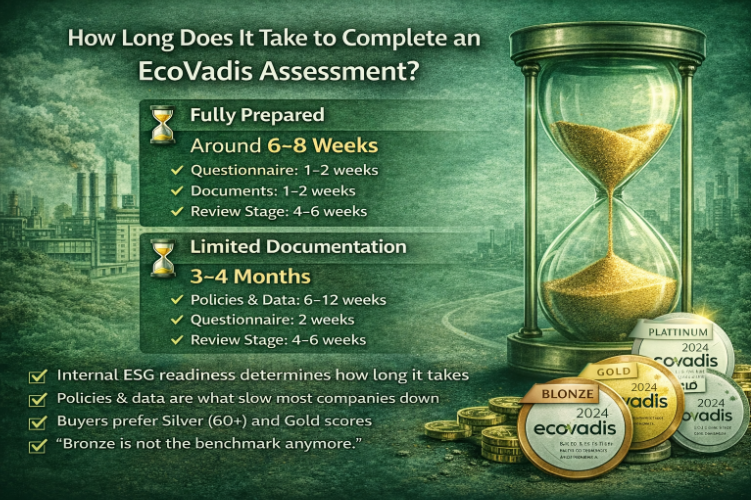
If Your Company Already Has Policies & Data
- Questionnaire completion: 1–2 weeks
- Document compilation: 1–2 weeks
- Review by EcoVadis: 4–6 weeks
Total: Approximately 6–8 weeks
If Your Company Has Limited ESG Documentation
- Policy drafting & internal approval: 4–8 weeks
- Data collection & carbon calculations: 2–4 weeks
- Questionnaire completion: 2 weeks
- Review stage: 4–6 weeks
Total: 3–4 months
If You Are Starting from Scratch
Some companies underestimate the preparation stage.
If you do not have:
- Environmental policy
- Carbon tracking
- HR code of conduct
- Ethics framework
- Supplier code
Then preparation may take 4–6 months.
EcoVadis itself does not take that long.
Internal alignment does.
How Long Does It Take to Complete an EIS?
EIS typically stands for Environmental Impact Study or Environmental Impact Statement.
This is different from EcoVadis.
An Environmental Impact Assessment (EIA or EIS) is a regulatory process required for certain industrial or infrastructure projects.
Typical timelines:
- Baseline study collection: 2–3 months
- Environmental impact modelling: 1–2 months
- Report preparation: 1–2 months
- Approval process: variable
Total: 6–12 months (depending on project type)
EcoVadis assessment is much shorter because it evaluates sustainability management systems, not physical project impact.
How Long Does an Environmental Impact Assessment Take?
Since this question often appears in similar searches, here’s a clear answer:
In India, a full Environmental Impact Assessment can take:
- 6 months for moderate projects
- 9–12 months for large infrastructure or industrial units
It involves:
- Field surveys
- Public consultation
- Government review
- Expert appraisal
EcoVadis does not require field studies. It evaluates documentation and management systems.
How Much Does EcoVadis Certification Cost?
EcoVadis pricing depends on:
- Company size
- Subscription plan
- Features selected
Small companies pay less than large multinational firms.
Costs typically include:
- Annual subscription fee
- Internal preparation costs
- Consultant support (if engaged)
While EcoVadis does not publicly disclose exact standardised fees across all cases, companies should budget for:
- Platform subscription
- ESG documentation development
- Carbon footprint calculation (if required)
The real cost is often internal time and resource allocation.
What Is the Document Limit for EcoVadis?
EcoVadis allows a limited number of supporting documents per question.
While limits may vary by subscription type and questionnaire structure, generally:
- You cannot upload unlimited documents.
- Relevance matters more than volume.
Uploading 100 irrelevant documents will not increase your score.
Each document must:
- Directly support a specific answer
- Be recent (usually within the last 2 years)
- Clearly demonstrate implementation
Quality > Quantity.
Why Companies Take Longer Than Expected
Most delays happen because:
- Policies exist, but are not formalised
- Carbon data is not structured
- Responsibilities are unclear internally
- Documentation is outdated
- Management approval is slow
EcoVadis scoring is documentation-driven.
If your internal systems are informal, preparation takes longer.
How to Speed Up EcoVadis Assessment
If you want to complete the assessment efficiently:
- Conduct an internal ESG gap assessment first
- Draft the required policies before starting the questionnaire
- Prepare carbon and energy data early
- Assign one internal ESG coordinator
- Align HR, procurement, and compliance teams
- Review previous customer audit documents
- Ensure documents are signed and dated
Preparation before submission saves weeks.
What Score Should You Aim For?
Many suppliers are satisfied with Bronze.
But increasingly, buyers prefer:
- Silver or higher
- Score above 60
Improving score often requires:
- Formal ESG strategy
- Carbon reduction targets
- Supply chain due diligence
- Ethics monitoring systems
Higher scores require deeper integration of sustainability practices.
Is EcoVadis Mandatory?
EcoVadis is not a government requirement.
Understanding the EcoVadis Assessment Time
It becomes mandatory when:
- A customer makes it part of the supplier onboarding process
- A multinational includes it in contract conditions
- ESG ratings impact procurement eligibility
In many industries, it’s becoming commercially expected.
When Should You Start the Process?
Start early if:
- A client has requested it
- You plan to bid for large contracts
- You want to improve supplier credibility
- You want to strengthen ESG positioning
Waiting until a deadline compresses preparation time and reduces score quality.
The Reality About EcoVadis Timelines
The platform review stage is structured. The preparation stage is what determines how long it takes.
If your systems are mature, you move quickly. If ESG is new internally, the process becomes a transformation exercise.
EcoVadis is not just a questionnaire. It is a mirror of how structured your sustainability management actually is.