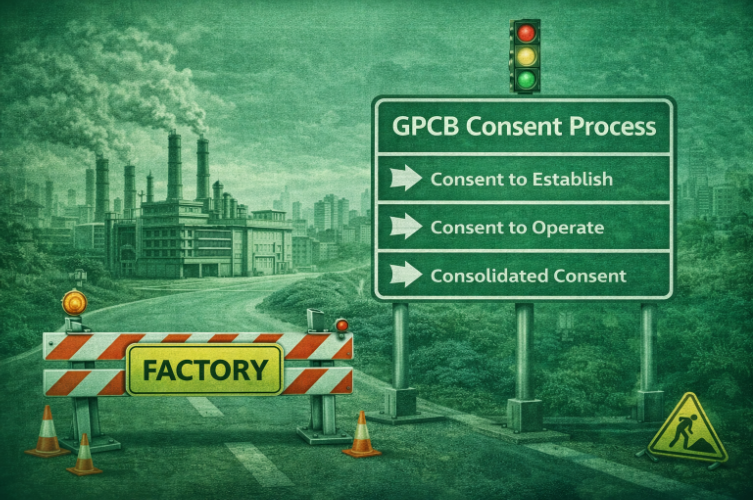
GPCB consent process Gujarat
If you’re starting or expanding a factory in Gujarat, one approval you cannot ignore is GPCB consent.
Understanding the GPCB consent process Gujarat is crucial for compliance.
Yet many factory owners only understand it when a consultant tells them, “You need CTE first. Then CTO.”
And that’s where confusion begins.
What is Consent to Establish?
What is Consolidated Consent & Authorisation?
How much does it cost?
Is it the same as a factory license?
What is Form 37?
Understanding the GPCB Consent Process Gujarat
Let’s break this down clearly, step by step — without legal jargon.
First, What Is GPCB?
GPCB stands for Gujarat Pollution Control Board.
It operates under:
-
- The Water (Prevention and Control of Pollution) Act
-
- The Air (Prevention and Control of Pollution) Act
-
- The Environment Protection Act
If your factory generates:
-
- Air emissions
-
- Wastewater discharge
-
- Hazardous waste
-
- Noise pollution
-
- Solid waste
You must obtain consent from GPCB before starting operations.
This is not optional.
What Is Consent to Establish (CTE) in Gujarat?
Consent to Establish (CTE) is the first approval required before you:
-
- Start construction
-
- Install machinery
-
- Begin civil work
-
- Set up pollution control equipment
CTE confirms that your proposed factory layout, pollution load, and treatment systems comply with environmental norms.
Without CTE:
-
- You should not begin installation
-
- You risk show-cause notices
-
- Your project can be halted
Many factories make the mistake of beginning setup before receiving CTE approval. That often becomes expensive later.
Step-by-Step Process to Get GPCB Consent
Let’s walk through the structured process.
Step 1: Identify Your Industry Category
GPCB classifies industries into:
-
- Red Category (High pollution potential)
-
- Orange Category (Moderate pollution)
-
- Green Category (Low pollution)
-
- White Category (Minimal pollution)
Your category determines:
-
- Documentation required
-
- Consent fees
-
- Inspection frequency
-
- Pollution control norms
Misclassification can delay approval.
Step 2: Prepare Required Documents
For a CTE application, you typically need:
-
- Project report
-
- Manufacturing process flow
-
- Land ownership or lease documents
-
- Site layout plan
-
- Details of raw materials
-
- Details of products
-
- Water consumption calculation
-
- Effluent generation calculation
-
- Air emission details
-
- Proposed pollution control systems
-
- Hazardous waste details
Documentation must align with the actual planned production capacity.
Inconsistent data is one of the biggest reasons for delays.
Step 3: Apply Online Through the GPCB Portal
Applications are submitted via GPCB’s online system.
You must:
-
- Register the unit
-
- Select an appropriate industry category
-
- Upload all required documents
-
- Pay applicable fees
Incomplete applications often result in objections.
Step 4: Technical Scrutiny & Inspection
After submission:
-
- GPCB reviews your documents
-
- Queries may be raised
-
- Site inspection may be conducted
During inspection, officers check:
-
- Site location
-
- Distance from residential areas
-
- Proposed pollution control equipment
-
- Layout compliance
Clear documentation reduces inspection friction.
Step 5: Grant of Consent to Establish (CTE)
If approved, GPCB grants CTE with conditions.
These conditions typically include:
-
- Installation of specific pollution control equipment
-
- Monitoring requirements
-
- Waste disposal norms
-
- Compliance with emission standards
CTE usually has a validity period.
Step 6: Install Plant & Pollution Control Systems
Only after receiving CTE should you:
-
- Install machinery
-
- Complete civil work
-
- Set up the Effluent Treatment Plant (ETP)
-
- Install air pollution control devices
Skipping this sequence creates legal exposure.
Step 7: Apply for Consent to Operate (CTO)
Once installation is complete, you apply for Consent to Operate (CTO).
CTO confirms that:
-
- Pollution control systems are installed
-
- Effluent treatment is operational
-
- Emission control devices are functioning
-
- Waste handling is compliant
Without a CTO, production cannot legally begin.
What Is Consolidated Consent and Authorisation in GPCB?
Consolidated Consent & Authorisation (CCA) is a combined approval that includes:
-
- Consent under the Water Act
-
- Consent under the Air Act
-
- Hazardous waste authorisation
Instead of separate approvals, GPCB issues one consolidated certificate.
This simplifies compliance management.
Many medium and large industries operate under CCA.
What Is the Cost of a GPCB License in Gujarat?
There is no fixed flat fee.
The cost depends on:
-
- Industry category (Red/Orange/Green)
-
- Capital investment
-
- Pollution potential
-
- Type of consent (CTE, CTO, CCA)
-
- Validity period
For small green category units, fees may be relatively low.
For large red category industries with higher capital investment, consent fees increase significantly.
In addition to government fees, companies often incur costs for:
-
- Consultant charges
-
- Environmental studies
-
- Monitoring reports
-
- Pollution control equipment
The exact cost varies from case to case.
How to Get a Factory License in Gujarat?
Many business owners confuse GPCB consent with a factory license.
They are not the same.
A factory license is issued under the Factories Act by the Directorate of Industrial Safety and Health (DISH).
To obtain a factory license:
-
- Submit building plan approval
-
- Apply under the Factories Act
-
- File Form 37 (if applicable)
-
- Obtain inspection clearance
-
- Receive license approval
GPCB consent is environmental clearance. A factory license is for labour and safety compliance.
Both are mandatory for industrial operations.
What Is Form 37 as per the Gujarat Factory Rules?
Form 37 is typically related to:
-
- Notice of occupation under the Factories Act
-
- Details about the factory manager
-
- Workforce information
-
- Machinery details
-
- Safety compliance
It is submitted during factory registration and licensing.
This is separate from GPCB but often processed during the same project timeline.
Common Mistakes That Delay GPCB Consent
From practical experience, most delays happen due to:
-
- Incorrect industry category selection
-
- Underreporting production capacity
-
- Incomplete wastewater calculation
-
- Not planning adequate ETP capacity
-
- Poor site layout planning
-
- Applying for CTO before full installation
-
- Ignoring consent conditions
Proactive planning prevents objections.
How Long Does the GPCB Consent Process Take?
Timelines vary depending on:
-
- Industry category
-
- Completeness of application
-
- Inspection schedules
-
- Query resolution speed
Green category units may receive approval faster.
Red category units may require more scrutiny and take longer.
Proper documentation significantly reduces approval time.
Why You Should Not Treat GPCB Consent as a Formality
Many factory owners see consent as just a license to operate.
But it affects:
-
- Bank financing
-
- Export eligibility
-
- Investor due diligence
-
- Expansion approvals
-
- Inspection exposure
If your CTE and CTO do not match your current production capacity, renewal complications arise.
Environmental compliance is not a one-time approval. It is an operational system.
When Should You Engage an Environmental Consultant?
You should seek professional guidance if:
-
- You are starting a new factory
-
- You are expanding capacity
-
- You are adding new product lines
-
- You received a show-cause notice
-
- Your consent renewal is due
-
- You want to convert separate approvals into consolidated consent
Experienced consultants help:
-
- Prepare technically accurate documentation
-
- Align production data with compliance limits
-
- Design appropriate pollution control systems
-
- Reduce approval delays
-
- Prevent future regulatory exposure
Preparing for 2026 and Beyond
Regulatory monitoring in Gujarat is becoming more data-driven.
Online reporting, periodic monitoring, and environmental audits are tightening.
Factories that build structured compliance systems from the beginning operate with less stress.
The real advantage is not just getting approval. It is being maintained smoothly.