As ESG reporting becomes more structured in India, companies are facing a practical decision:
Should we hire an ESG consultant? Or build an in-house ESG compliance team?
At first glance, it feels like a cost comparison.
But it’s actually about expertise, scalability, risk exposure, and long-term strategy.
Let’s break this down clearly — including the difference between consulting and in-house roles, ESG vs compliance, salary expectations, and who is ultimately responsible for ESG compliance.
First: What Is the Difference Between Consulting and In-House?
This is the foundation of the debate.
In-House Team
An in-house ESG or compliance team works as part of your organisation.
They:
- Operate full-time within your company
- Understand internal systems deeply
- Coordinate across departments
- Handle ongoing reporting and documentation
They are embedded in your daily operations.
ESG Consultant
An ESG consultant is an external expert or firm that:
- Works on a project or retainer basis
- Brings cross-industry experience
- Implements ESG frameworks
- Guides strategy and reporting alignment
- Conducts gap assessments and audits
Consultants provide expertise. In-house teams provide continuity.
The real question is: which stage is your company in?
What Is the Difference Between ESG and Compliance?
This confusion often affects decision-making.
Compliance
Compliance is about meeting legal and regulatory requirements.
Examples:
- Filing BRSR (for listed companies)
- Environmental approvals
- Labour law adherence
- Reporting under SEBI norms
Compliance ensures you meet minimum standards.
ESG
ESG goes beyond legal compliance.
It includes:
- Sustainability strategy
- Carbon reduction targets
- Supply chain transparency
- Governance frameworks
- Ethical oversight
- Climate risk management
Compliance is reactive. ESG is strategic.
A compliance team ensures you follow rules. An ESG function ensures you build long-term resilience.
Who Is Responsible for ESG Compliance?
Ultimately, responsibility sits at the top.
Under structured frameworks like BRSR and global ESG standards:
- The Board of Directors holds accountability
- Senior management oversees implementation
- ESG or compliance officers manage execution
- Department heads supply operational data
ESG is not just an environmental department task.
It requires:
- Finance team input
- HR data
- Procurement transparency
- Operations emissions data
- Governance oversight
Whether you choose a consultant or an in-house, board-level awareness is critical.
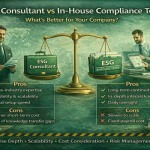
Comparing ESG Consultant vs In-House Team
Let’s look at this practically.
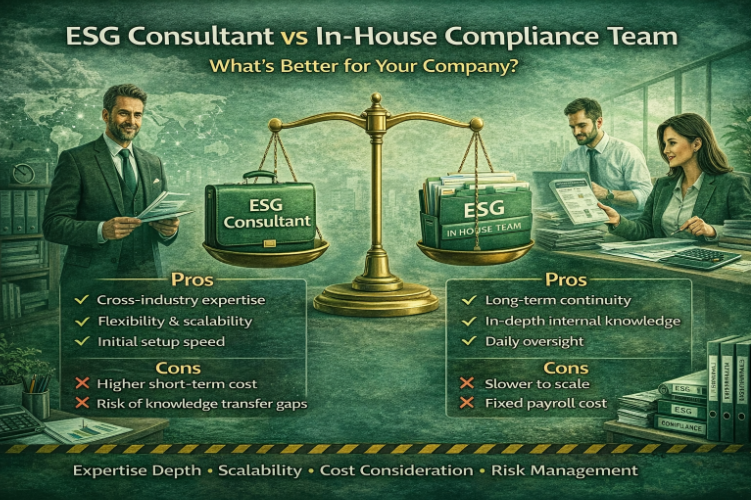
1. Expertise Depth
ESG Consultant
- Works with multiple industries
- Understands the latest global standards
- Familiar with GRI, SASB, IFRS, BRSR, EcoVadis
- Knows audit expectations
- Brings benchmarking insights
In-House Team
- Strong internal knowledge
- May lack cross-industry exposure
- Learning curve if ESG is new
If your company is new to ESG, consultants often accelerate maturity.
2. Cost Consideration
What Is the Salary of an ESG Consultant?
In India, ESG consultant salaries vary depending on experience:
- Entry-level ESG analyst: Moderate salary range
- Mid-level ESG consultant: Higher bracket
- Senior ESG strategist: Significantly higher compensation
If hiring full-time, you must consider:
- Salary
- Benefits
- Training
- Software tools
- Retention risk
Hiring a full ESG team increases fixed costs.
Consultant Cost Model
- Project-based fees
- Retainer-based model
- Limited engagement duration
- No long-term payroll burden
For mid-sized companies, consultants often cost less than building an internal ESG department.
3. Scalability
In-House Team
- Stable long-term control
- Slower to scale quickly
- Limited bandwidth during peak reporting season
ESG Consultant
- Can scale support quickly
- Brings additional specialists
- Faster implementation during audits
If facing urgent ESG reporting deadlines, consultants provide speed.
4. Knowledge Retention
In-House Team
- Builds internal capability
- Retains data systems
- Maintains year-on-year continuity
ESG Consultant
- Knowledge may not fully transfer
- Requires structured handover
- Dependency risk if long-term reliance
Companies often combine both: a consultant for setup, in-house person for maintenance.
5. Risk Management
ESG involves:
- Carbon reporting
- Supply chain due diligence
- Ethical compliance
- Governance disclosure
Mistakes in ESG reporting can impact:
- Investor confidence
- Bank financing
- Customer contracts
- Regulatory scrutiny
Consultants reduce risk through experience. In-house teams reduce risk through control.
When Is an ESG Consultant Better?
An ESG consultant may be better if:
- You are starting ESG reporting for the first time
- You need the BRSR framework alignment
- You are preparing for EcoVadis
- You face CBAM requirements
- You need a carbon footprint calculation
- You want faster maturity
- You lack internal ESG expertise
Consultants are especially useful during:
- Initial setup
- Gap assessment
- Policy drafting
- Carbon inventory preparation
- Verification preparation
When Is an In-House ESG Team Better?
An internal team may be better if:
- ESG reporting is ongoing annually
- You operate in a highly regulated industry
- You require daily sustainability oversight
- You manage multiple global supply chains
- You aim for long-term ESG integration
Large corporations typically combine:
- In-house ESG department
- External consultants for audit and validation
The Hybrid Model: Often the Smartest Choice
Many companies adopt a hybrid approach:
- Hire an ESG consultant to:
- Conduct baseline gap assessment
- Develop policies
- Build a reporting structure
- Prepare carbon inventory
- Align with standards
- Conduct baseline gap assessment
- Train the in-house team to:
- Maintain data collection
- Monitor compliance
- Update documentation
- Coordinate departments
- Maintain data collection
This balances expertise and internal continuity.
What Is the Difference Between Compliance and Consulting?
This question appears frequently in search.
Compliance Role
- Ensures rules are followed
- Files required documentation
- Tracks deadlines
- Maintains records
Consulting Role
- Designs systems
- Advises on strategy
- Identifies risk
- Improves ESG performance
- Enhances score ratings
Compliance maintains the status quo. Consulting drives improvement.
Decision Checklist: What Should You Choose?
Ask yourself:
- Do we have ESG expertise internally?
- Are we preparing for first-time ESG reporting?
- Do we face investor scrutiny?
- Is our carbon data structured?
- Do we need fast implementation?
- Is ESG part of our strategic growth?
If most answers show uncertainty, external support may be required.
ESG in 2026 and Beyond
ESG expectations are intensifying due to:
- BRSR expansion
- Global sustainability standards
- Carbon border regulations
- Supply chain transparency
- Investor pressure
Companies that treat ESG as a compliance checkbox often struggle.
Companies that integrate ESG strategically gain:
- Stronger investor positioning
- Better supply chain acceptance
- Lower operational risk
- Improved brand credibility
The real choice is not consultant vs in-house.
It is whether ESG is reactive or structured.
Building ESG maturity is a process.
Some companies start with consultants.
Some build internal teams.
Most successful ones combine both.
The right model depends on your company size, risk exposure, industry category, and long-term sustainability vision.