Common GPCB Compliance Mistakes Manufacturing Units Make (and How to Avoid Them)
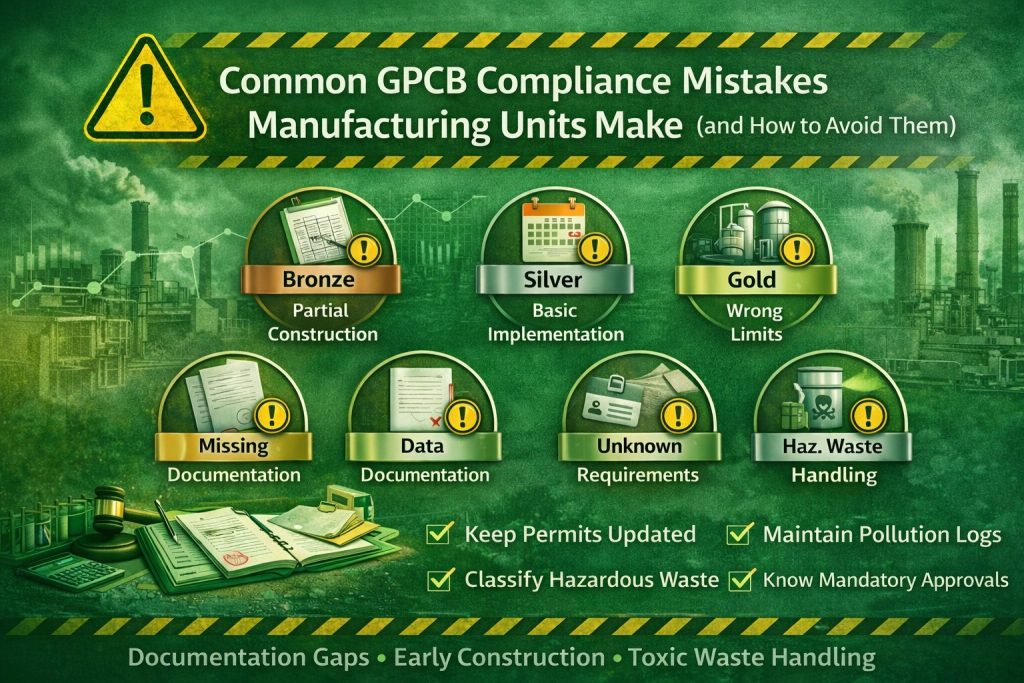
Most Gujarat Pollution Control Board (GPCB) compliance issues do not arise because manufacturing units ignore environmental responsibility. They happen because documentation, monitoring systems, and waste-handling records fail to reflect what is actually happening on the factory floor. When operational reality and regulatory paperwork drift apart, compliance breaks down.
GPCB compliance is not a one-time approval or a periodic filing exercise. It is an operational system that must remain aligned with production levels, utilities, waste generation, and monitoring practices every day. Units that treat compliance as an occasional task often face show-cause notices, consent renewal delays, inspection risks, or operational disruptions.
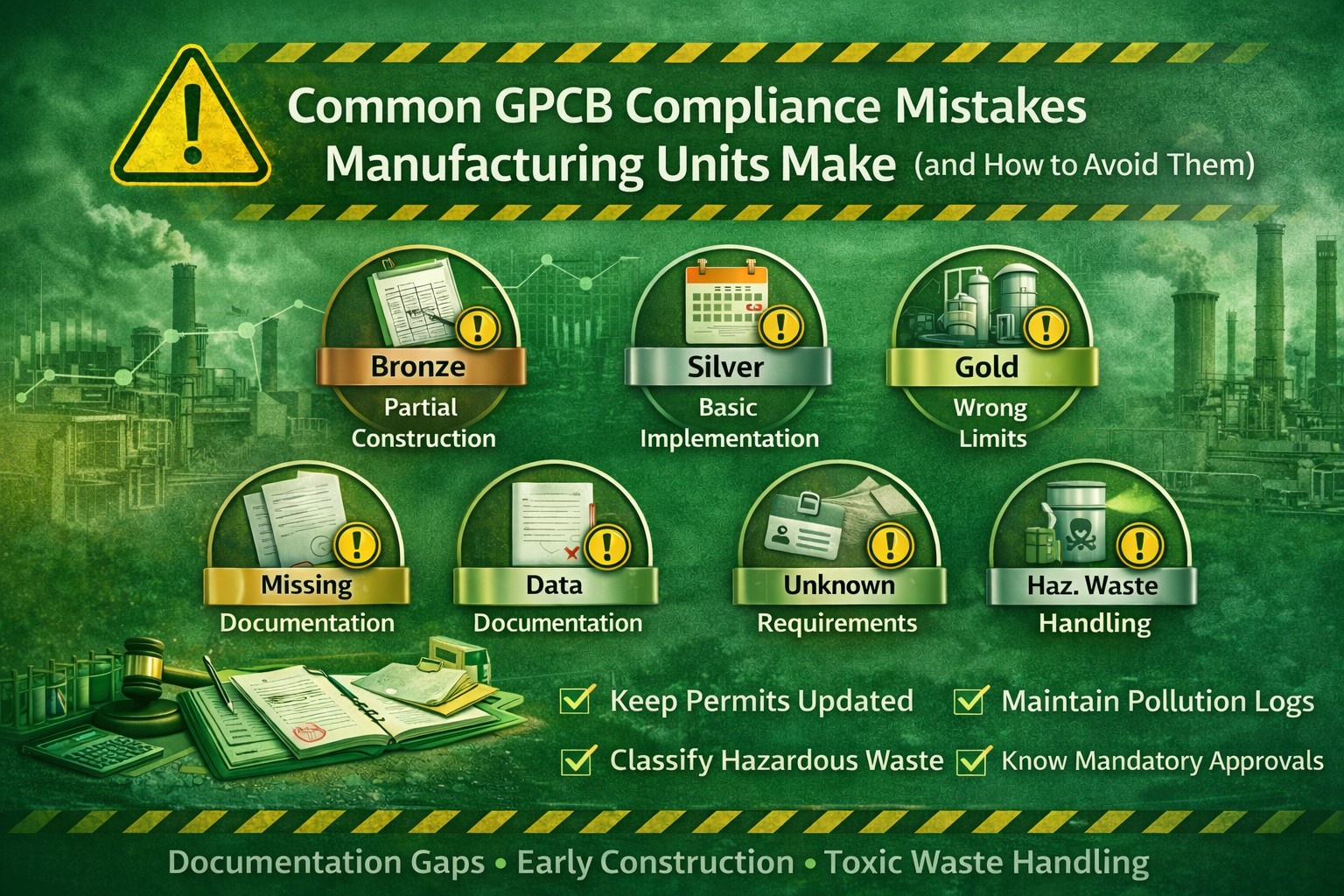
The 7 GPCB Compliance Mistakes That Trigger Notices, Delays, and Renewals Getting Stuck
Mistake 1: Treating CTE as a Formality and Starting Work Too Early
Many manufacturing units treat Consent to Establish (CTE) as a procedural checkbox and begin civil work, machinery installation, or trial production before approvals are granted. This is one of the most common triggers for regulatory notices.
What is CTE in GPCB?
CTE (Consent to Establish) is the approval required before setting up, expanding, or modifying an industrial unit. It covers layout, installed capacity, pollution control systems, and proposed operations.
Why does this become a problem?
Once physical work starts without CTE, even a technically compliant setup can be flagged as a violation during inspections or renewal reviews.
How to avoid it
Macro Impact on India
Treat CTE like a construction permit, not paperwork. Build a strict CTE-first checklist before:
- Civil construction
- Machinery installation
- Utility setup
Trial production
Mistake 2: Confusing CCA and CTO and Missing Renewal Windows
Many units are unclear about which approval governs operations and when renewals are due, especially when consolidated approvals are issued.
What is CCA in GPCB?
GPCB often issues consolidated consent (CC&A), where operational consent and authorisations are bundled together. In practical terms, this is the approval that allows the plant to legally operate.
Why does this cause delays?
Missed renewal windows, expired authorisations, or partial renewals can halt operations, delay expansions, or trigger notices.
How to avoid it
Maintain a simple compliance calendar covering:
- Consent validity dates
- Hazardous waste authorisation validity
- ETP/STP monitoring schedules
- Stack and ambient air monitoring schedules
This single system prevents most renewal-related failures.
Mistake 3: Misunderstanding “Permissible Limits”
This is where many manufacturing units unknowingly slip into non-compliance.
What are the permissible limits for GPCB?
There is no single universal limit. Permissible limits depend on:
- Industry category (Red, Orange, Green, White)
- Consent-specific conditions
- Applicable Air, Water, and Environment Protection rules
Discharge route (CETP, STP, ZLD, or direct discharge)
Why units get trapped
Units rely on generic internet values or outdated standards instead of their own consent conditions.
How to avoid it
Create an internal Limits Sheet with:
- Parameter
- Allowed limit (from consent or applicable rule)
- Testing frequency
- Latest test resul
- Laboratory report reference
This converts compliance from assumption-based to controlled.
Mistake 4: Pollution Control Equipment Exists, but Logs Don’t
Many units install ETPs, scrubbers, and filters correctly but fail inspections due to missing proof of operation.
Common gaps include:
- Missing maintenance logs
- No calibration records
- Inconsistent flow meter readings
- Lab reports that do not match production schedules
- Missing maintenance logs
Why is this risky
GPCB evaluates evidence of operation, not just equipment presence.
How to avoid it
Adopt a proof-first compliance system:
- Daily ETP inlet and outlet logs
- Chemical dosing records
- Sludge handling logs
- Air monitoring schedules
- Monthly lab report folders
If it is not logged, it is treated as non-existent.
Mistake 5: Chemical Waste Disposal Is Handled Informally
Improper hazardous waste handling is a major inspection red flag.
Best practice for chemical waste disposal A compliant system includes:
- Correct waste classification
- Labelled storage
- Manifest tracking
- Authorised transporter
Authorised TSDF or processor
How to avoid issues Always keep these audit-ready:
- Waste inventory register
- Manifest copies
- Disposal certificates
Informal arrangements collapse immediately during inspections.
Mistake 6: Assuming “White Category” Means “No Compliance”
White category industries are often misunderstood.
Are white industries exempt from obtaining CTE under GPCB?
White category units are generally exempt from CTE and CTO requirements, subject to self-declaration or intimation as per CPCB and GPCB guidelines.
Where units go wrong
They assume exemption means zero documentation.
How to avoid it
Even if exempt, maintain:
- Self-declaration or intimation records
- Waste and effluent handling evidence, if applicable
Exemption does not mean immunity.
Industry classification proof
Mistake 7: Not Knowing Which Certificates Are Actually Required
Many units expect compliance to be covered by a single certificate.
Reality
Compliance usually involves a set of approvals:
- CTE (before setup or expansion)
- CCA or CTO (to operate)
- Waste authorisations (hazardous, solid, plastic, e-waste, etc.)
How to avoid confusion
Create a one-page Compliance Map showing:
- Approval name
- Validity period
- Responsible person
- Evidence folder location
This single document saves months of confusion.
Why Pollution Control Measures Are Hard to Implement in Real Factories
Compliance breaks down when systems are not designed for operational reality. Manufacturing environments are dynamic:
- Production volumes fluctuate
- Staff turnover happens
- Vendors change
- Logs become optional under pressure
Most compliance failures are not technical. They are failures of operational discipline. Unless compliance is embedded into daily routines, it eventually collapses.
How Can Pollution Be Controlled by the Manufacturing Industry?
Effective pollution control works in three layers:
Layer | What It Means | What GPCB Looks For |
Prevention | Reduce waste at source | Process optimisation |
Control | Treat emissions and effluents | ETP, STP, scrubbers |
Proof | Demonstrate compliance | Logs, lab reports, manifests |
Units that focus only on control equipment and ignore proof are the most vulnerable.
How Can Businesses Achieve Complete Compliance With Safety and Effluent Regulations?
A practical compliance system looks like this:
- Read consent conditions like a contract
- Translate conditions into SOPs
- Measure on defined schedules
- Store evidence month-wise
- Conduct quarterly internal reviews
This approach prevents last-minute scrambling before inspections.
What Is the Penalty for Environmental Pollution?
Penalties depend on:
- The law violated (Water Act, Air Act, Environmental Protection Act)
- Severity and duration of violation
They may include fines or imprisonment under applicable statutes.
Practical reality
Most units first experience:
- Show-cause notices
- Consent renewal holds
- Closure risk
Reputational and commercial impact
What Is the Cost of a GPCB License in Gujarat?
Fees vary based on:
- Industry category
- Scale of operations
- Consent type
- Nature of activity
GPCB publishes official fee schedules, and costs change with capacity and classification.
What Is the Primary Benefit of Compliance With the Air (Prevention and Control of Pollution) Act?
The benefit is not just legal protection. Business-level advantages include:
- Fewer shutdown risks
- Smoother renewals and expansions
- Safer workplaces
- Easier customer and exporter audits
- Fewer surprise retrofit costs
Compliance stability directly supports business continuity.
Frequently Asked Questions
Yes. Units generating emissions, effluents, or waste require applicable approvals based on industry category.
CTE is required before setup or expansion, while CTO or CCA allows legal operation.
As specified in consent conditions, typically monthly or quarterly.
Yes. Verified emissions data is mandatory under CBAM rules.
Yes. Classification proof and self-declarations are still required.
From Firefighting to Systems
If your unit is stuck in renewals, receiving notices, or unsure what applies, the fastest fix is not more paperwork. It is a clean compliance system aligned with real operations.
At GreenMinds India, we help manufacturing units translate consent conditions into SOPs, monitoring schedules, and audit-ready documentation so GPCB compliance becomes routine, not a fire drill.
Discover Related Blogs
ESG for Pharma Companies: Why It’s Becoming a Business Necessity in 2026
ESG for Manufacturing Companies: Why It’s Becoming a Competitive Advantage in 2026